


呵呵
US says it found health and safety violations at GM plant in Ohio_我的网站

一 |
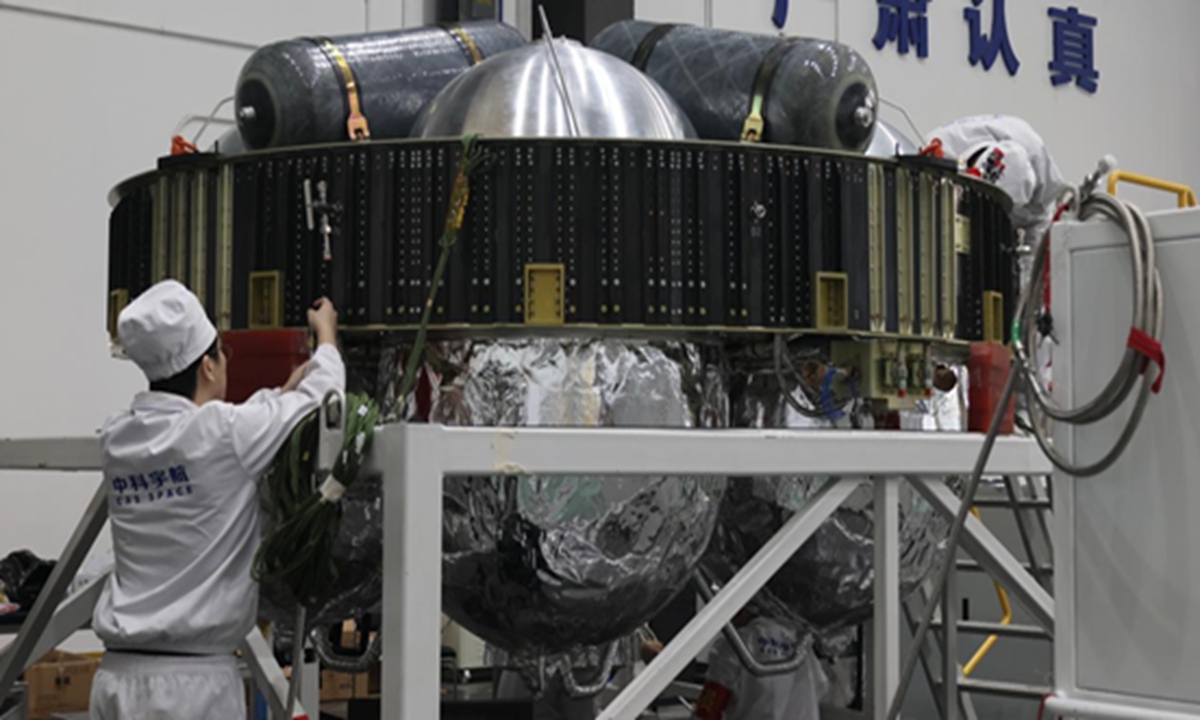
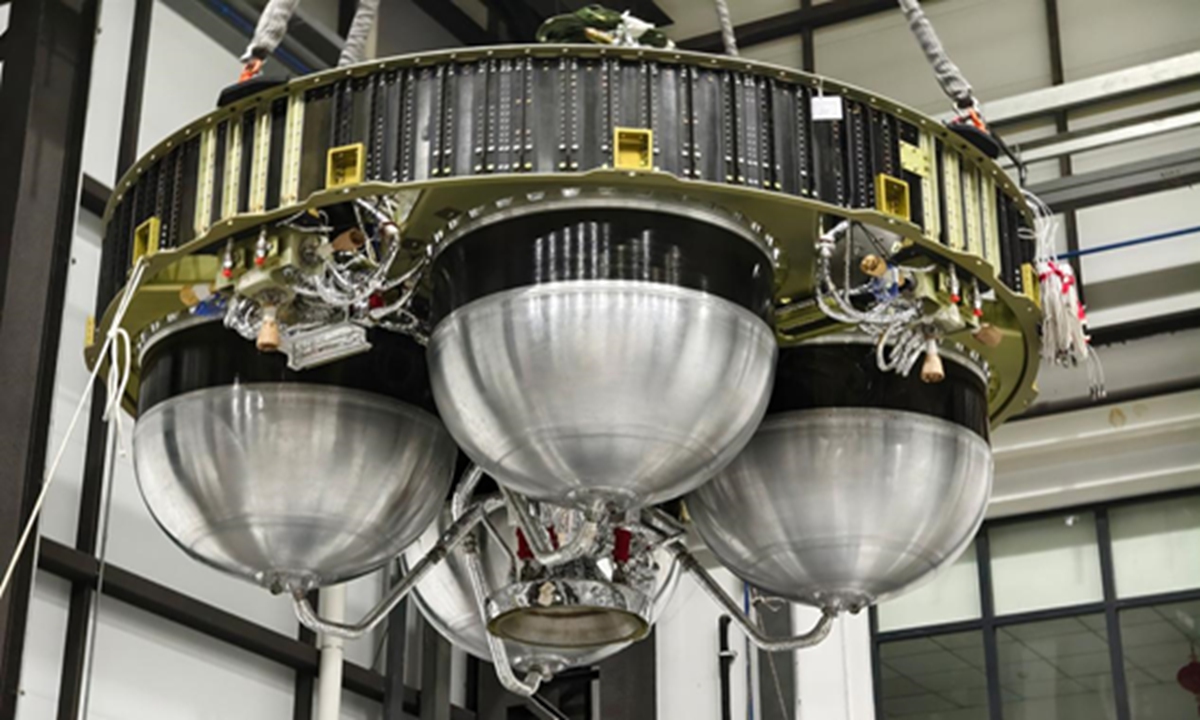
Lixun-1 upper stage, a versatile "space tug" developed by China's commercial space firm CAS Space, is scheduled to make its maiden flight in the first quarter of 2027 after completing a series of key propulsion-system tests, the developer and its chief designer told the Global Times on Tuesday.
The "tug" is designed to ferry satellites from one orbit to another and support missions ranging from constellation deployment to lunar exploration.
While the main stages of a rocket carry payloads from the ground into an initial orbit, an upper stage takes over once the craft is in space. By repeatedly restarting its engine and changing orbit, Lixun-1 can deliver satellites to higher or different orbits, distribute multiple spacecraft to separate destinations during a single launch, or send probes onto trajectories toward the moon and beyond, Global Times learned from the developer.
Yang Haoliang, chief designer of the Lixun-1 upper stage, compared the system to a shuttle service. "If the regular stages of a launch vehicle are like a long-distance bus," - they carry the upper stage and satellites from Earth to a near-Earth parking orbit - the upper stage then takes over as a "space tug," carrying its satellite "passengers" onward to their designated orbital "stops," Yang explained.
That capability can have a direct impact on how efficiently satellites are launched and operated, Yang said. If a satellite has to climb from an initial orbit to its final destination using its own engine, the process can consume a considerable amount of onboard propellant and reduce the fuel available during its operational life. An upper stage can instead perform that orbital transfer, helping conserve satellite fuel and potentially extend its service life.
It can also make one rocket launch do more work. Instead of releasing a batch of satellites into roughly the same orbit, Lixun-1 can repeatedly ignite its engine and maneuver between deployments, sending different satellites to different altitudes and inclinations. Yang said this would help accelerate constellation deployment while improving the efficiency of individual launches.
The practical ambitions behind the system are backed by a major technical milestone reached this month. In August, Lixun-1 completed its PV-001 integrated propulsion-system coordination firing test, during which the entire system operated smoothly for 566 seconds.
Yang told the Global Times that the current Lixun-1 upper stage has a thrust of 20 kilonewtons and can achieve a specific impulse of 315 seconds, which he described as reaching an internationally leading level. The August firing covered the planned profile for the maiden mission, an important step before the system proceeds to flight testing.
The test was more than a demonstration of the engine itself. As an important system-level verification during development, it examined the coordination and engineering reliability of the engine pressurization system, propellant delivery system, propellant management system and servo-control system under the fully integrated configuration.
Of a series of tests that accumulated 5,211 seconds of firing time, the latest one focused on three core technologies: a high-thrust, high-performance 20-kilonewton upper-stage engine capable of multiple starts; balanced propellant delivery from multiple parallel tanks; and a highly reliable integrated electrical system. Their successful verification means Lixun-1 has completed its system-level testing and is ready to move into the flight-test phase, according to the developer.
Lixun-1 has been designed as a modular and generally adaptable upper stage rather than a system tied to only one rocket. It is intended to work with CAS Space's Kinetica-2 and Kinetica-2 heavy-lift variants as well as other launch vehicles, Yang said.
When paired with the Kinetica-2 family, Lixun-1 could significantly expand the rocket's mission range. For communications missions, it could deliver satellites to geosynchronous transfer orbit or even directly to geosynchronous orbit, conserving satellite propellant while supporting the deployment of high-throughput satellites and future 6G communications spacecraft.
For multi-satellite missions, the combination could distribute spacecraft to different orbital altitudes and inclinations during a single launch, potentially serving both low-Earth-orbit constellations and medium- or high-orbit payloads. For deep-space missions, it could place probes onto Earth-moon transfer trajectories and support lunar exploration, Yang said.
The upper stage is designed to be able to conduct more than 20 engine ignitions, autonomously plan orbital-transfer routes and operate under the vacuum and extreme temperature conditions of space. After completing payload deployment, it can also carry out orbital disposal maneuvers to reduce space-debris risks.
Yang said the Lixun-1 and Kinetica-2 combination is designed to cover the vast majority of commercial satellite launch requirements while retaining the ability to participate in major national space projects. More broadly, the upper stage forms part of CAS Space's effort to build launch capabilities reaching medium and high Earth orbits and deep space, extending the reach of China's commercial space sector toward higher orbits and more distant destinations.
。 DETROIT -- The U.S. Labor Department said Thursday that investigators found 19 safety and health violations at a General Motors joint venture electric vehicle battery plant in Ohio during a two-week period this year.The department's Occupational Safety and Health Administration has proposed fining Ultium Cells LLC $270,091 for the alleged violations at a recently opened factory in Warren, Ohio. The plant, a joint venture between General Motors and LG Energy Solution, started making battery cells in 2021.The Labor Department said inspectors found that Ultium Cells didn't comply with federal safety standards for use of personal protective equipment including respirators. They also found that the company didn't install guards on machines or train workers in procedures to control hazardous energy, and it failed to provide eye wash stations, emergency showers and hand protection, among other violations.“Ultium Cells’ technology and advanced manufacturing facilities are part of a new and emerging field, but workplace safety standards — such as machine guarding, personal protective equipment and emergency response training — have been the law for decades,” OSHA Cleveland Area Director Howard Eberts said in the statement.The agency says Ultium Cells has 15 business days from the date it received the citations to comply, request an informal conference or contest the findings with an independent commission.Ultium Cells said in a statement Thursday that it requested a hearing with OSHA. “We look forward to a constructive dialogue with OSHA and hope to resolve these issues quickly and reinforce our commitment to fostering a safety-first mindset among all Ultium team members,” the company said.Authorities began investigating the plant after an explosion and fire in March. It did four inspections between April 24 and May 5, the statement said.。
Current article:http://rwuy.shuicengchongmingnouhuawang.bond/news/20260826_33846.html
Published on:12:48:31
 学位法通过,2025年1月1日起施行
 哈利伯顿不满联盟赛程安排:看到复出首战客战鹈鹕 我直接愣住了
 联合开发部:与小米合作良好,不停产
 TikTok Shouldn’t Be TikDoc
 济南森林公园不仅有绿意,还有书香
 OpenAI要让AI替代“初级投行员工”
 杭州发布雷电黄色预警
 亮剑国际舞台!国产抗日新作《抵抗者》全新预告将至
 苏群:勇士这几年难有大作为 两年1.367亿续约库里一秒都不要犹豫
 福州新区(长乐区):“五全”招商激活文旅新动能
 Out-of-work Chinese actors turn to theme parks as immersive characters after AI squeezes short-drama jobs
 《江西省先进制造业集群培育管理办法》 新闻发布会在南昌召开